Positions, not platitudes.
What matters in international business and contract law. And how companies make that knowledge work for them.
Featured
Knowledge Management
AI gives answers. Your company needs the right ones.
Language models are becoming interchangeable. Your company’s legal knowledge is not. Why knowledge management is the infrastructure question for every business that works with contracts.
International Business Law
CISG: advantages and disadvantages for German exporters
Why the reflex of excluding the CISG costs exporters protection: scope of application, contracting states, and the pros and cons compared with German domestic sales law.
Standard Terms
How to incorporate standard terms internationally
How standard terms become part of the contract in international business, and what happens when both sides’ terms collide (battle of forms).
All articles

Data and AI in contracts: what may your counterparty do with your data?

Data license, machinery supply contract, SaaS: why control over your data hinges on the line between adaptation and transformation, and how the contract captures AI training and competing products.

IP clauses in contracts: who owns what, and who may use it
Background, foreground, and joint IP, ownership versus the right to use: how an IP clause allocates rights between the parties, with notes on US copyright from derivative works to fair use.

Open access to international business law
A curated, freely accessible collection of literature, case law, and resources on international business law. Continuously updated, suggestions welcome.

Incoterms® 2020: A Reality Check
A critical look at the Incoterms 2020 rules: why clause selection usually fails in practice, and where the rules themselves carry weaknesses or set the wrong incentives.

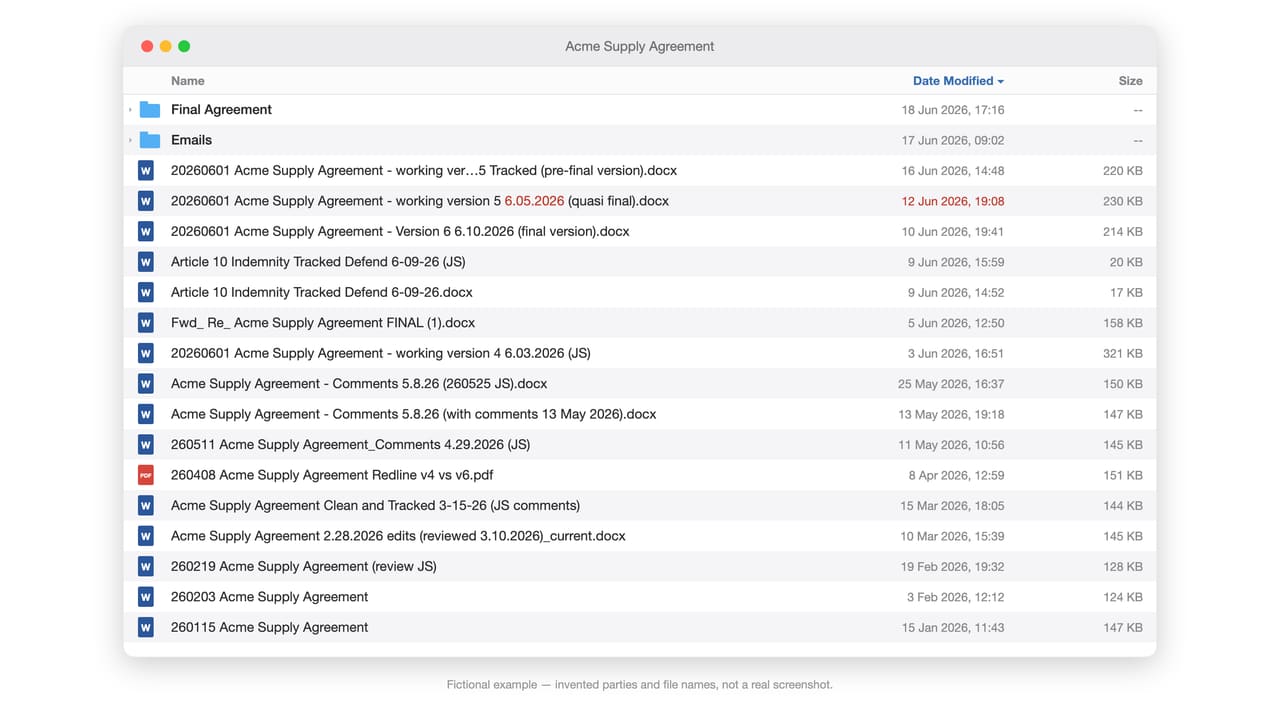
File names: a scheme that holds
Why the wrong file version keeps getting signed, and a simple ISO 8601 naming scheme that prevents it.

Commercial law in companies: the knowledge gap
A study shows: employees often do not know the basics of commercial law, at home or across the border. What that costs and how training helps.

Indemnity: how the supplier can reduce its liability
The “indemnity” clause is critical in commercial contracts and often used incorrectly. How to dial it back from the supplier side.

Incoterms® 2020: practical overview
The structural and substantive changes in Incoterms 2020 vs. Incoterms 2010, plus practical guidance for choosing the right Incoterms clause.

Commercial Courts in Germany: an alternative for international disputes
Germany’s new Commercial Courts hear major commercial disputes in English. Jurisdiction, advantages, and how to compare them to international arbitration.

No exclusion of private international law
The usual exclusion of private international law in choice-of-law clauses is superfluous and incorrect. The fix is simple.

Best practice for handling foreign law
The Hamburg Guidelines support German courts, experts, and parties in handling foreign law in international disputes — what they say and how to use them.

Proof of receipt of an email
Case law on the burden of proof for email, fax, read receipts, and secure delivery methods, plus practical guidance for time-critical declarations.

All Cap Clauses in Commercial Contracts
Contract parties often use capitalized clauses in commercial contracts. This makes reading unnecessarily hard. There is a simple solution.

As far as legally permissible? Not a good idea.
A contract clause with the rider “to the extent permitted by law” is invalid. In a forum-selection clause, this becomes a serious problem.

How to withdraw from a purchase contract correctly

How to withdraw from a purchase contract correctly: requirements, deadlines, place of supplementary performance, and practical recommendations.

International Arbitration Procedures: Evidence Gathering in the USA
The discovery process is essential in the United States for preparing litigation. Also in international arbitration?

No oral side agreements exist. But they do!
The German Federal Court of Justice (BGH) ruled on the validity of the clause ‘No oral side agreements exist’ in standard terms.

Incoterms® 2020 FCA and CPT – Best practice

This guidance paper is relevant to users of the Incoterms 2020 rules for shipping goods in containers through ports anywhere in the world.

Modern Contract Language
Inaccurate, redundant, or outdated contract language causes problems. Here are some examples and suggested wording.

No individual agreement
A pre-formulated clause stating that the parties have supposedly negotiated each term individually is counterproductive, and in many cases legally void.

“No re-export to Russia”: compliant export contracts

Export contracts must include a “no re-export to Russia” clause from 20 March 2024. EU model clause, German contract-law pitfalls, and what to add.

Effective protection of trade secrets
Requirements for confidentiality measures and the burden of pleading and proof in trade-secret cases, with notable rulings on catch-all employment clauses.

How to Sabotage an Organization
Timeless “lessons” from the Simple Sabotage Field Manual by the US Office of Strategic Services (1944) on sabotaging an organization.

How to Avoid U.S. Tariffs as an International Supplier
This article shows how to avoid tariffs as a supplier by using the appropriate Incoterms 2020 clause in your supply contracts with U.S. buyers.
No articles match this selection.